


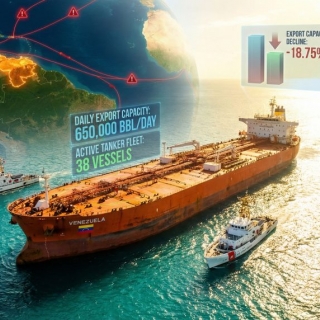
The renewed tensions in Venezuela have begun to draw attention from global market participants, primarily due to the potential disruption to global oil supplies. As the country with the world's largest oil reserves, every political and geopolitical dynamic in Venezuela often has a direct impact on global energy price movements.
The main market concern centers on the possibility of disruptions to Venezuelan oil production and exports, either due to domestic instability or the potential for a re-tightening of international sanctions. This situation risks tightening global oil supplies, especially as energy markets remain sensitive to geopolitical issues in major producing regions.
From a market perspective, this increased supply risk tends to push oil prices higher, as market participants adjust to potential imbalances between supply and demand. This situation also increases uncertainty in the energy market, which is already overshadowed by other geopolitical tensions and the production policies of major producing countries.
The knock-on effects of rising oil prices are not limited to the energy sector. Rising energy prices have the potential to drive global inflationary pressures, as transportation and production costs also increase. This is a concern for central banks, including the Federal Reserve, which is closely monitoring inflation developments before making decisions on interest rate policy.
In financial markets, escalating tensions in Venezuela are also impacting investor sentiment. Risk assets tend to move more cautiously, while safe havens like gold and the US dollar are likely to find support as global uncertainty increases. On the other hand, energy sector stocks typically benefit from the prospect of higher oil prices.
Overall, tensions in Venezuela add to the list of geopolitical factors currently overshadowing global markets. Although the full impact has not yet been fully realized, market participants will continue to monitor developments in the situation, given its significant role in determining the direction of oil prices, inflation, and global financial market stability. (cay)
Source: Newsmaker.id
Renewed tensions between the United States and Russia have resurfaced following an incident involving an oil tanker, sparking market concerns about potential disruptions to global energy supplies. Was...
According to a report from the US Department of Labor (DOL) released on Thursday, the number of Americans filing new applications for unemployment insurance rose to 208,000 for the week ending January...
Geopolitical issues have heated up again after statements and political signals from the United States sparked speculation about a possible US takeover of Greenland. Although no concrete action has be...
Private employment rose less than economists expected in December, according to the ADP report. Private employment rose 41,000 (Estimate +50,000) in December, compared with a revised -29,000 in Novem...
Greenland is not only a strategic location, but also a world-class mineral repository. The island holds vast reserves of rare earth elements (REEs), essential for modern technology. These minerals are...
Oil prices stabilized on Thursday (February 12th), as the market reassigned a risk premium to US-Iran tensions despite US inventory data showing swelling domestic supplies. This movement confirms one thing: geopolitical headlines are still more...
Gold prices weakened slightly on Thursday (February 12th), as more solid US employment data reduced market confidence in an imminent Federal Reserve interest rate cut. The strong employment data prompted market participants to shift expectations of...
The Hang Seng Index reversed its downward trend in Hong Kong on Thursday (February 12th), weakening by around 0.9% to around 27,000 after a strong session earlier. This decline halted the momentum of the short term rally, as investors began to...